Overview
One simple swap
Method
Codebook-Aligned Prediction
Multi-level action tokenizers
An action tokenizer maps a continuous action chunk to a sequence of discrete tokens \(c_1,\ldots,c_L\), one per quantization level.
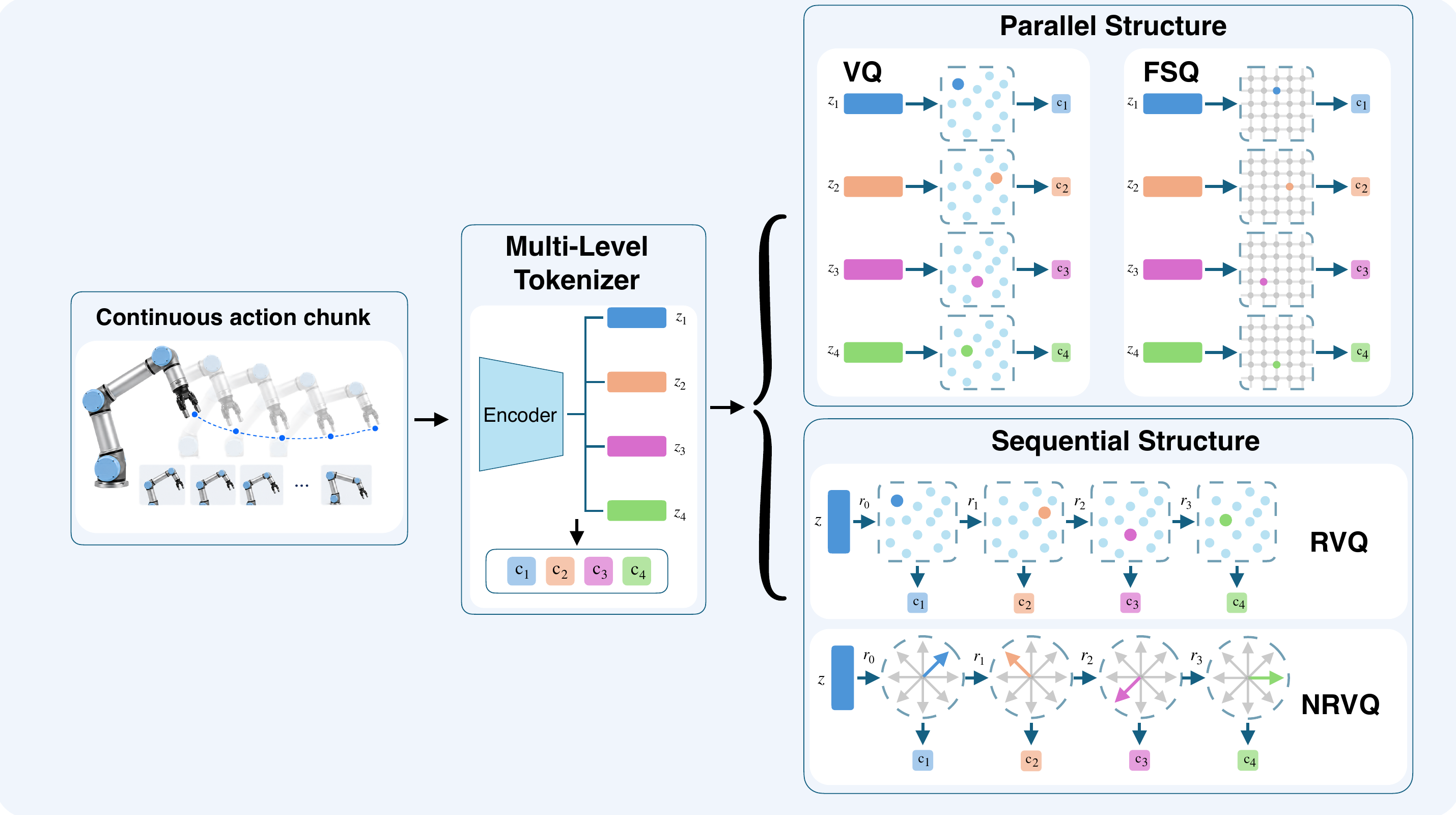
Tokenizer–policy mismatch
A standard autoregressive policy typically uses a single head (SH), with one categorical classifier shared across quantization levels.
MH outperforms SH in eleven of the twelve level-specific comparisons
Success rate (%), Table I, level-specific (-L) tokenizers.
Codebook-aligned prediction
CAP reuses tokenizer code vectors as class prototypes in the policy classifier and scores output representations by their distance to these prototypes.
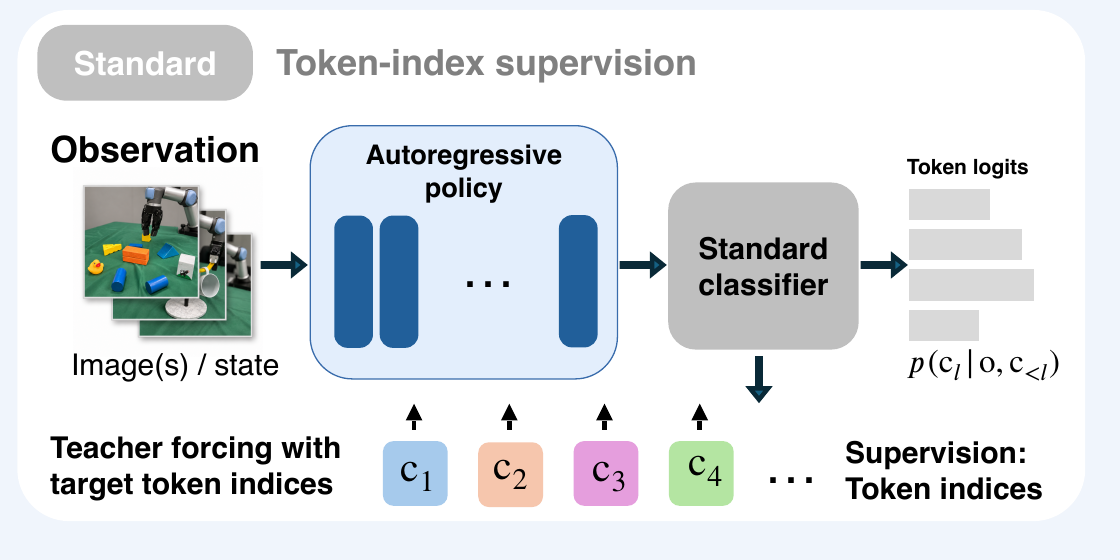
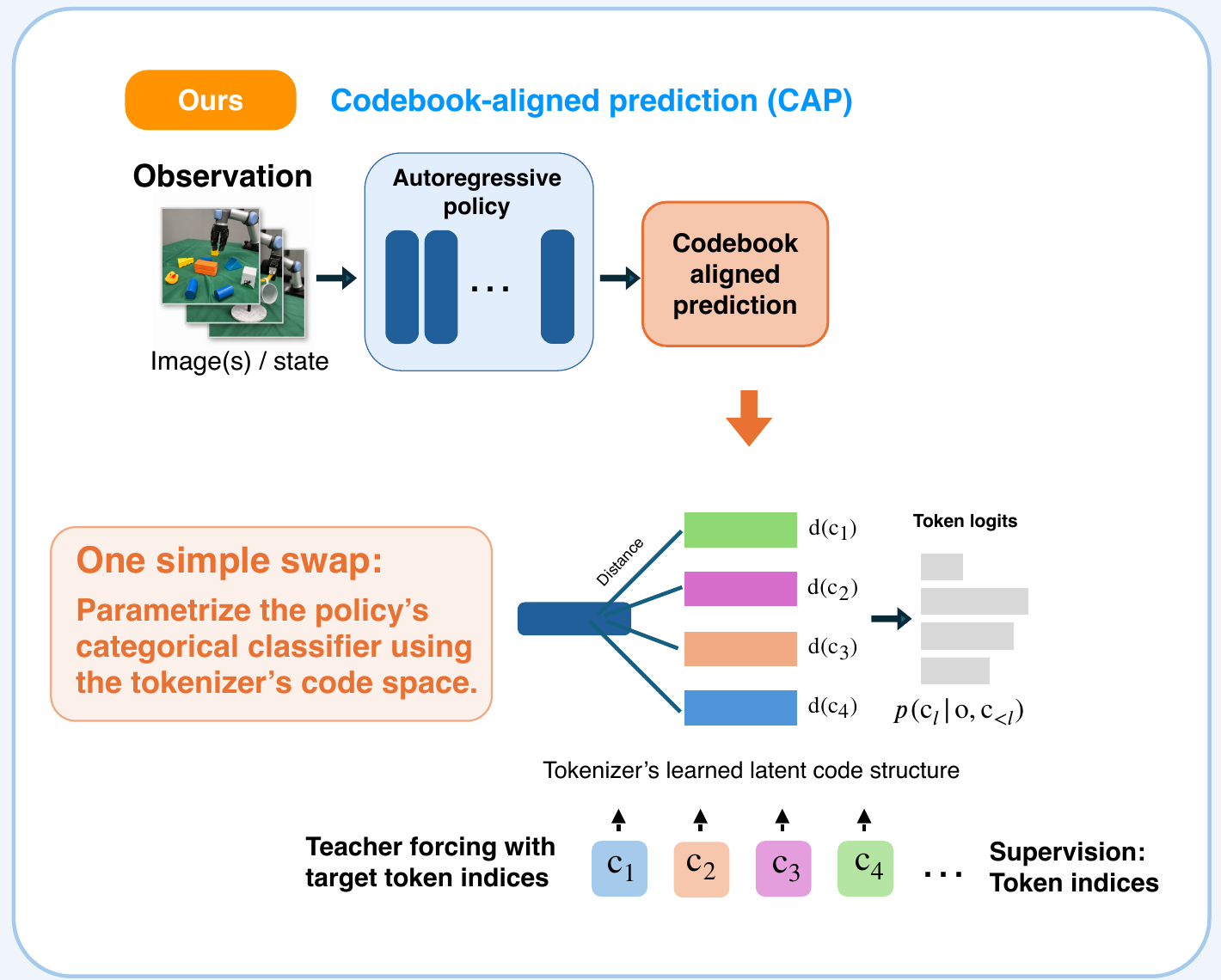
CAP yields more benign errors
Click any code. Each arrow is the action that code decodes to. Schematic
Results
Simulation Results
CAP − baseline, per task and tokenizer (pp)
Click a cell to watch its rollout.
Success rate per tokenizer (Table I)
Notes
Simulation rollouts
Paired rollouts: baseline vs. CAP
Each pair uses the same tokenizer and the same evaluation episode index; only the prediction heads differ. Both clips play on one shared timeline.
Top row: CAP. Bottom row: baseline. Columns: VQ-S, VQ-L, RVQ-S, RVQ-L, NRVQ-S, NRVQ-L, FSQ-S, FSQ-L (the column order of Table II). Every tile holds its final frame until the longest clip finishes.
Analysis
Error and mechanism analyses
Error analysis
CAP does not improve the token prediction accuracy; instead, it is more robust to token prediction errors and observation perturbations, yielding more benign errors in action space.
Mechanism analysis
CAP's gains are not explained by head parameterization alone, but are driven by action-aware codebook structure and improved policy backbone representations.
RoboMimic, eight quantizers. Details in the paper.
Real robot